| 1. Autogenous Bone |
The patient’s own bone, commonly harvested from the mandibular ramus, chin, tuberosity, or iliac crest. |
Living bone containing mineral, collagen matrix, osteogenic cells, and native growth factors. |
Provides osteogenesis, osteoinduction, and osteoconduction. Particulate grafts may remodel relatively quickly; cortical blocks can maintain a better contour but still undergo remodeling. |
Large horizontal or vertical ridge defects, block grafting, and selected sinus or staged reconstruction procedures. |
Strong biological potential and no risk of immune incompatibility between donor and recipient. |
Requires a second surgical site, has limited available volume, and may cause postoperative pain, swelling, sensory disturbance, or donor-site morbidity. |
Often considered the biological reference material, although less invasive alternatives may provide comparable clinical outcomes in many localized defects. |
| 2. Mineralized Cortical Allograft |
Human donor bone obtained from a regulated tissue bank. |
Processed mineralized cortical bone containing a natural human mineral and collagen framework. |
Generally remodels more slowly than cancellous particles and can provide useful space maintenance. Human histologic remnants may remain during early healing, which can support contour stability. |
Socket preservation, ridge augmentation, lateral ridge reconstruction, and some sinus augmentation procedures. |
Good handling, human-derived matrix, and relatively predictable maintenance of grafted volume when protected by a stable membrane or flap. |
Variable remodeling between patients; it is not a living autograft and may show limited osteogenic activity. |
A commonly selected allograft for maintaining ridge dimensions, with clinical studies supporting its use in extraction sockets and implant-site development. |
| 3. Freeze-Dried Demineralized Bone Allograft |
Human donor bone processed by freeze-drying and partial or substantial mineral removal. |
Collagen-rich human bone matrix with reduced mineral content; the amount of residual mineral varies by preparation. |
Usually remodels faster than mineralized cortical allograft. Demineralization may expose bone proteins, but the degree of osteoinduction is variable and cannot be assumed for every preparation. |
Socket preservation, contained periodontal or peri-implant defects, and mixed grafting procedures. |
Human collagen matrix, favorable packing characteristics, and potential biological activity when used in a well-contained defect. |
Less resistant to collapse than dense cortical particles; clinical behavior depends on donor processing, mineral content, defect containment, and membrane stability. |
Useful when faster remodeling is preferred, but it is generally less suitable as a stand-alone material for large non-contained defects requiring prolonged space maintenance. |
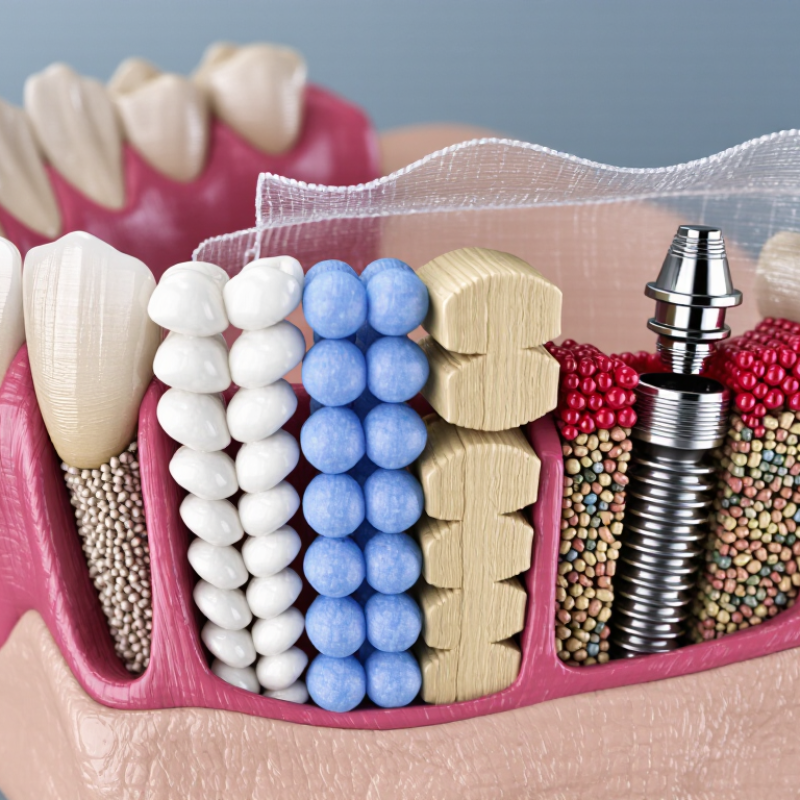
| 4. Bovine-Derived Anorganic Bone Mineral |
Bovine bone processed to remove organic components and reduce antigenic material. |
Highly porous hydroxyapatite-like mineral with interconnected macro- and microporosity. |
Slow resorption or limited replacement is characteristic. Histologic studies frequently report residual particles after months or years, helping support long-term volume stability. |
Extraction-socket preservation, sinus-floor elevation, horizontal ridge augmentation, and peri-implant contour enhancement. |
Excellent space maintenance, favorable scaffold architecture, and extensive clinical experience in implant-site development. |
Slow turnover may leave residual particles; it does not provide living cells and should be used with careful infection control and appropriate defect management. |
One of the best-documented xenograft categories for maintaining augmented ridge and sinus volume, especially when mechanical stability is maintained. |
| 5. Porcine-Derived Collagenous or Mineral Graft |
Porcine bone or porcine collagen processed for use as a graft or graft-associated matrix. |
May contain mineralized xenogeneic particles, collagen, or a combination of both, depending on the processing method. |
Mineralized forms can provide moderate-to-slow resorption and useful space maintenance; collagen components generally resorb more quickly. |
Socket management, minor ridge defects, guided bone regeneration, and soft-tissue-supported contour procedures. |
Good handling and a natural collagen or mineral scaffold; may be useful when a balance between remodeling and volume preservation is desired. |
Clinical evidence is more heterogeneous than for bovine mineral; long-term volume behavior depends strongly on the specific tissue source and processing method. |
A reasonable xenograft option for selected contained defects, but claims about equivalence to bovine mineral should be based on product-specific clinical evidence. |
| 6. Equine-Derived Bone Mineral |
Equine bone processed to produce a mineral scaffold. |
Porous calcium-phosphate mineral with a structure intended to support blood clot retention and bone ingrowth. |
Generally provides gradual remodeling and useful defect support, although the rate varies with particle size, porosity, processing, and clinical environment. |
Socket preservation, localized ridge augmentation, periodontal defects, and selected sinus procedures. |
Porous architecture, moldability, and potential for prolonged scaffold function. |
Fewer long-term comparative studies are available than for the most extensively studied bovine materials; outcomes remain technique- and case-dependent. |
Can be considered for selected implant-site procedures, but comparative evidence should be reviewed before using it for large or complex defects. |
| 7. Synthetic Biphasic Calcium Phosphate |
Synthetic, laboratory-produced ceramic; no human or animal tissue is required. |
A controlled mixture of hydroxyapatite and beta-tricalcium phosphate, with the ratio influencing resorption behavior. |
Hydroxyapatite contributes to slower resorption and stability, while beta-tricalcium phosphate generally resorbs more rapidly. The balance can provide both scaffold persistence and gradual replacement. |
Socket preservation, contained ridge defects, sinus augmentation, and guided bone regeneration when adequate containment is present. |
Unlimited theoretical supply, no donor-tissue disease transmission, consistent composition, and tunable resorption characteristics. |
No intrinsic osteogenic cells or organic growth-factor matrix; loose particles may migrate in non-contained defects unless stabilized. |
A well-supported alternative for contained defects, with performance influenced by ceramic composition, particle size, membrane protection, and surgical technique. |








 System Features
 Key Features
 Key Features
 Key Features
 Key Features
 Key Features
 Key Features
 Key Features
 Key Features
 Key Features