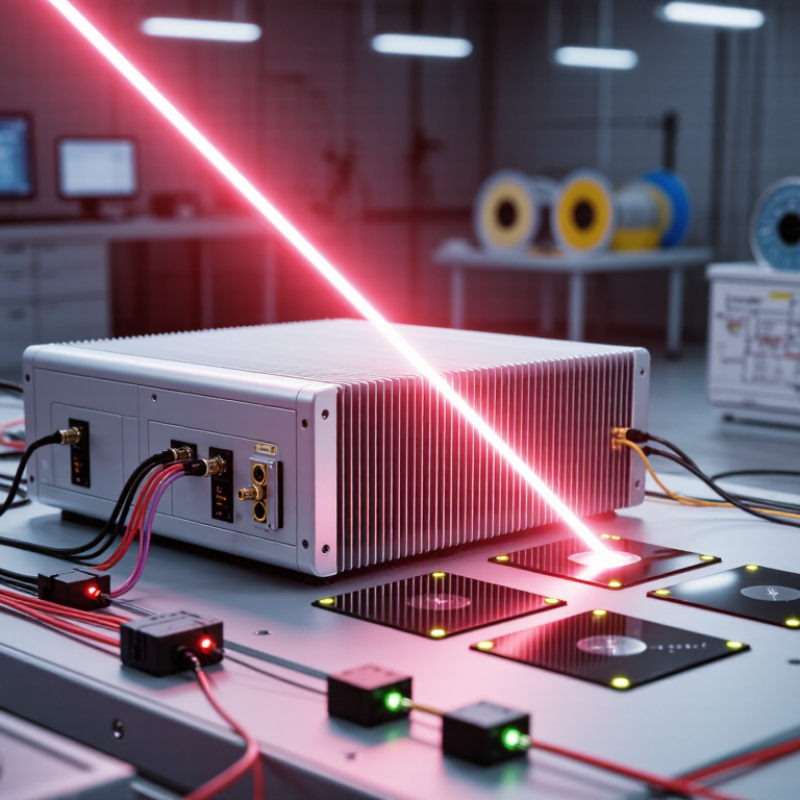
| Operating Principle | Semiconductor laser diode coupled into an optical fiber | Electrical energy is converted into laser light, which is confined and guided through the fiber core. | Fiber-coupled pumping, material processing, medical equipment, sensing, and communications. | Confirm whether the product is intended as a pump source, a direct-diode source, or a signal source. |
| Pump Wavelength | Approximately 793–805 nm
Approximately 915–976 nm | The wavelength determines how efficiently the diode can pump the active gain medium and affects thermal management. | Around 793–805 nm: selected for specific absorption characteristics in some rare-earth-doped fibers.
Around 915–976 nm: widely used for ytterbium-doped fiber pumping. | Match the diode wavelength to the absorption band of the active fiber. A wavelength mismatch can reduce efficiency. |
| Output Power | Less than 1 W to several watts: compact systems
Tens of watts: industrial modules
Hundreds of watts: high-power pump assemblies | Output power affects achievable laser power, processing speed, and the required cooling capacity. | Low power for sensing and compact instruments; higher power for cutting, welding, cladding, and pumping fiber amplifiers. | Choose enough power for the application while avoiding unnecessary thermal load and electrical consumption. |
| Electrical-to-Optical Efficiency | Commonly about 30%–60%, depending on wavelength, drive current, temperature, and package design | Efficiency indicates how much electrical input is converted into useful optical output. | Important for battery-powered, air-cooled, and high-duty-cycle systems. | Compare efficiency at the actual operating current and temperature rather than relying only on a maximum rating. |
| Fiber Core Diameter | Typically about 50–600 µm for high-power pump delivery; smaller cores are used for lower-power applications | The core diameter influences power-handling capability, coupling tolerance, and beam quality. | Larger cores for high-power pumping; smaller cores where compactness or better spatial control is more important. | Ensure compatibility with the receiving fiber and verify the allowed power density at the fiber input. |
| Numerical Aperture | Common high-power fiber-coupled values are approximately 0.12–0.22 | Numerical aperture describes the range of angles that the fiber can accept or emit. | Determines coupling efficiency and compatibility with pump combiners, gain fibers, and optical assemblies. | The diode fiber NA should be compatible with the downstream optical system to minimize coupling losses. |
| Fiber Type | Multimode fiber
Polarization-maintaining fiber
Single-mode fiber | Fiber type affects beam quality, polarization stability, coupling requirements, and system complexity. | Multimode: high-power pumping and robust industrial systems.
Polarization-maintaining: polarization-sensitive applications.
Single-mode: applications requiring high beam quality. | Select the fiber type based on beam-quality requirements, not only on output power. |
| Spectral Bandwidth | Typically narrow enough for pumping, but exact bandwidth varies with diode structure and operating conditions | Bandwidth affects absorption efficiency, wavelength stability, and sensitivity to temperature. | Narrower spectra are useful when the gain medium has a narrow absorption feature or when wavelength control is critical. | Check center wavelength, spectral width, and wavelength shift over the full operating temperature range. |
| Cooling Method | Natural convection, forced air, conduction cooling, or liquid cooling | Cooling removes heat generated by electrical inefficiency and helps maintain stable output. | Air cooling for compact or moderate-power equipment; liquid cooling for high-power and continuous-duty systems. | Size the cooling system for worst-case ambient temperature and continuous operation, not typical laboratory conditions. |
| Operating Temperature | Often approximately 0–45 °C for controlled equipment; exact limits depend on the module | Temperature changes can affect wavelength, output power, lifetime, and coupling stability. | Industrial, outdoor, and mobile systems require broader environmental tolerance. | Verify both the diode operating range and the storage range, and include temperature-control requirements in the design. |
| Drive Current and Control | Constant-current operation with soft start, current limiting, and monitoring | Laser diodes are sensitive to current spikes and electrical transients. | All applications, especially systems requiring long operating life and repeatable optical output. | Use a properly matched driver with protection against overcurrent, reverse voltage, and uncontrolled startup. |
| Beam Quality | Single-mode or multimode; often specified using M², brightness, or étendue | Beam quality determines how efficiently the light can be focused, combined, or launched into another fiber. | High-brightness processing, precision marking, pumping, and beam-combining systems. | Do not select solely by power. Confirm M², near-field pattern, far-field divergence, and stability when relevant. |
| Modulation Capability | Continuous-wave, pulsed, or analog/digital modulation, depending on the driver and diode design | Modulation determines how quickly and accurately optical output can be controlled. | Continuous-wave for steady pumping; modulation for sensing, communications, marking, and process control. | Check modulation bandwidth, rise time, pulse limits, and the effect of modulation on thermal load. |
| Reliability and Lifetime | Often specified using expected operating hours under defined temperature and drive conditions | Lifetime depends strongly on junction temperature, drive current, contamination, vibration, and optical feedback. | Long-duty industrial equipment, medical devices, research instruments, and remote systems. | Operate below maximum ratings, maintain clean optical interfaces, and provide adequate heat removal. |
| Optical Safety | Laser safety classification depends on accessible output power and wavelength | Fiber-coupled light can remain hazardous even when the emitting spot is small or not visible. | Every system using a fiber laser diode. | Use suitable enclosures, interlocks, beam stops, warning labels, and wavelength-appropriate protective eyewear. |
| Best Overall Choice | A diode whose wavelength, power, fiber geometry, cooling, and control method match the complete system | The highest-rated diode is not always the most suitable or economical option. | Application-specific selection across industrial, scientific, medical, and communications systems. | Prioritize compatibility, thermal margin, required beam quality, reliability, and total operating cost. |





 System Features
 Key Features
 Key Features
 Key Features
 Key Features
 Key Features
 Key Features
 Key Features
 Key Features
 Key Features