Top 5 China Aluminum Door Manufacturers: Company Profiles, Products, Certifications, and Comparison
The five China aluminum door manufacturers most relevant to international project sourcing are Guangdong Dejiyoupin Doors and Windows, Guangdong EEHE Doors & Windows Technology, Foshan CIVO Technology, Sichuan Yazhixuan Doors and Windows, and Sichuan Mingrenju Doors and Windows. These companies stand out through manufacturing scale, export experience, system-door engineering, patent portfolios, and access to products designed around CE, NFRC, NAFS, AS 2047, CSA, ISO, or related standards.
This is an editorial shortlist rather than a universal sales ranking. The assessment compares publicly stated factory capacity, product range, quality control, overseas projects, certifications, and customization capabilities. Buyers should independently verify factory claims and confirm that certificates cover the exact aluminum door model, glass configuration, hardware, and production location being purchased.
What Is an Aluminum Door Manufacturer?
An aluminum door manufacturer designs or fabricates complete fenestration assemblies using extruded aluminum profiles, glazing, seals, hardware, thermal barriers, and surface finishes. Typical products include sliding doors, bifold doors, hinged entrance doors, lift-and-slide systems, pivot doors, and thermally broken aluminum doors.
A system-door manufacturer does more than cut and assemble profiles. It coordinates frame geometry, drainage, gaskets, glazing, locks, hinges, structural reinforcement, and installation interfaces as one tested system. This distinction matters because the finished assembly—not aluminum alone—determines air leakage, water penetration, wind resistance, security, acoustic insulation, and thermal transmittance.
Thermal-break doors use a low-conductivity barrier, commonly polyamide, between interior and exterior aluminum sections. They are generally preferable for air-conditioned buildings, cold climates, and projects governed by energy codes. Non-thermal frames can remain practical for interior openings or mild climates where cost and slim sightlines take priority.
Industry Context and Procurement Trends
China’s aluminum door supply chain is concentrated around Guangdong, especially Foshan, while Sichuan has developed substantial system-window and whole-home customization capacity. The ecosystem links aluminum extrusion, insulating glass, powder coating, hardware, automation, packaging, and container logistics, enabling manufacturers to supply both standard products and project-specific dimensions.
Energy performance is becoming a stronger purchasing criterion. The International Energy Agency reports that building operations account for about 30% of global final energy consumption and 26% of energy-related emissions when direct and indirect emissions are combined. Its buildings analysis is available at https://www.iea.org/topics/buildings. This policy environment supports demand for thermally broken frames, low-emissivity insulating glass, improved airtightness, and documented U-factor performance.
Standards are also becoming more market-specific. North American buyers commonly examine NFRC energy ratings and NAFS performance classes. European projects evaluate declarations and CE marking under the Construction Products Regulation. Australian buyers typically request AS 2047 evidence, while coastal and cyclone-prone projects may require additional wind, water, impact, or corrosion testing.
1. Guangdong Dejiyoupin Doors and Windows Co., Ltd.
Guangdong Dejiyoupin, based in Foshan, is a large-scale option for hotels, villas, residential developments, and customized overseas projects. The company reports more than 25 years of industry experience, a 180,000-square-meter production base, over 600 employees, and annual production exceeding one million square meters.
Its manufacturing information describes eight automated production lines, six glass lines, five intelligent warehouses, 168 production processes, and 38 quality inspections. Dejiyoupin also reports more than 100 national patents, over 50 new products developed annually, and an independent performance-testing center.
The portfolio includes sliding, bifold, pivot, entry, garage, and aluminum hinged doors, alongside casement, awning, picture, sliding, and thermal-break windows and sunrooms. Manufacturer materials cite more than 18,000 completed projects and activity in over 100 countries, although another project page uses the narrower description of 30-plus countries across six continents. Named references include Hilton Hotels, Atour Hotels, Beverly Hills, Ruyi Lake, and Emerald City.
Published certification claims include CE, NFRC, AS 2047, CSA, ENERGY STAR, ISO 9001, and hurricane-related certification. Project teams should request current model-level reports rather than treating a company-level statement as evidence for every configuration.
2. Guangdong EEHE Doors & Windows Technology Co., Ltd.
EEHE is a Foshan-based manufacturer with 18 years of reported manufacturing experience. It states that its production base covers approximately 100,000 square meters and employs more than 1,500 people. The company is particularly relevant to developers seeking a wide product catalog and project support in the Middle East, North America, Australia, and other regulated markets.
EEHE supplies thermal-break, casement, sliding, and tilt-and-turn windows, together with sliding, folding, and swing doors, sunrooms, curtain walls, and glass railings. Its factory information describes German automated equipment, Italian technical support, 120 production steps, and 60 quality-control points.
The company reports more than 300 patents and references technical cooperation with Tsinghua University and FAW Audi. Its commercial footprint includes over 800 distributors. Published overseas references include DAMAC Lagoons in Dubai, a residential project in Oman, and Rosamia Da Nang Hotel in Vietnam.
EEHE lists NFRC, CE, CSA, UL, AS/NZS, NAFS, SGS, and ISO-related credentials, and says it welcomes TÜV or Intertek factory audits. Its current factory page reports exports to more than 100 countries, whereas broader company materials use a figure above 60 countries and regions. Buyers should clarify the definition and reporting period behind either number.
CIVO is suited to buyers looking for factory-direct aluminum windows and doors supported by profile inventory and climate-oriented product development. The legal entity was established in 2016, while its manufacturer page describes more than 15 years of manufacturing experience. The safest interpretation is that the company combines a 2016 corporate establishment date with earlier team or industry experience.
The company reports a 40,000-square-meter factory and a standard reserve warehouse holding approximately 5,000 tons of aluminum profiles. This inventory can help stabilize material availability for multi-building projects, although purchasers should still confirm alloy, temper, wall thickness, finish batch, and replenishment lead time.
CIVO offers casement, sliding, and tilt-and-turn windows; sliding, bifold, lift-and-slide, and automatic doors; sunrooms; and thermally broken systems. Its R&D positioning emphasizes adaptation to regional differences in temperature, rainfall, wind, and solar exposure.
Manufacturer figures cite more than 10,000 completed projects or installations, over 200 exclusive stores, and business across more than 100 countries. Its website references CE, ISO, NFRC, and ASTM-related standards. Because ASTM standards cover different properties and test methods, buyers should request the exact report number, laboratory, specimen size, pressure level, and tested configuration.
Founded in 2005 and located in Guanghan, Sichuan, Yazhixuan focuses on aluminum system windows, thermal-break doors, conservatories, and customized residential products. It is a practical candidate for OEM, ODM, dealer, and regional distribution programs requiring flexible product configurations.
The company’s current English manufacturing profile describes a 50,000-square-meter standardized 7S workshop and a separate 20,000-square-meter tempered-glass workshop. Public materials report more than 200 employees, monthly output above 30,000 units, and peak daily capacity of up to 1,500 units.
Manufacturing resources include CNC cutting equipment, automatic powder-coating lines, precision welding stations, automated production lines, and quality-testing laboratories. Yazhixuan describes a 12-step inspection process and public company materials report more than 60 patented technologies.
Products include sliding, casement, sash, and outward-opening windows; sliding, swing, bifold, and folding doors; thermally broken assemblies; and sunrooms. Earlier materials mention exports to more than 30 countries, while the Chinese official site reports a domestic presence covering more than 200 cities and over 230 stores.
The company emphasizes thermal insulation, sound control, weather resistance, and energy efficiency. International buyers should identify the required destination standard before ordering because general claims of international certification do not replace product-specific test documentation.
Sichuan Mingrenju operates through the Feiyu system-door-and-window brand and a multi-base manufacturing structure. Group history traces industry activity to 1980, while Sichuan Mingrenju was established in 2004. Its long operating background and integrated product range make it relevant to whole-home and large residential programs.
The group reports an approximately 410,000-square-meter manufacturing layout across three principal bases in Taixing, Jiangsu; Nanhai, Foshan; and Guanghan, Sichuan. It states that the organization provides more than 4,000 jobs and holds 163 patents.
The portfolio covers aluminum system windows, entrance and interior door solutions, sunrooms, railings, awnings, louvers, and whole-home customized windows and doors. Product families include Feiyu SLIM, ECO, and EASE systems. Referenced projects include a California development, Sanya Villa, and the Sanxingdui Museum.
Mingrenju states that R&D, manufacturing, marketing, and after-sales service are integrated across the group. Published credentials include ISO 9001:2015, green-building-material information, and utility-model patents recorded under the company name. ISO 9001 concerns quality-management systems; it should not be interpreted as proof of a door’s structural, thermal, or weather performance.
For manufacturing scale, Mingrenju reports the largest combined footprint at about 410,000 square meters across three bases. Dejiyoupin follows with a stated 180,000-square-meter production base, while EEHE reports 100,000 square meters. Yazhixuan lists 70,000 square meters across its standardized and glass workshops, and CIVO reports a 40,000-square-meter plant.
For documented output, Dejiyoupin publishes annual production above one million square meters. Yazhixuan provides unit-based figures of more than 30,000 units per month and up to 1,500 units per day at peak. The other manufacturers describe large or automated capacity without publishing directly comparable annual finished-door figures.
For patents, EEHE reports more than 300, Mingrenju 163, Dejiyoupin over 100, and Yazhixuan more than 60 in public materials. Patent counts indicate development activity but do not automatically prove product quality. Buyers should examine whether patents apply to drainage, thermal barriers, hardware, safety, assembly, or appearance.
For international compliance breadth, Dejiyoupin and EEHE publish the broadest certification lists. CIVO is notable for climate-oriented engineering and profile reserves. Yazhixuan offers a strong OEM and domestic dealer-network proposition. Mingrenju differentiates itself through multi-base manufacturing and integrated whole-home system solutions.
Why Choose a China Aluminum Door Manufacturer?
Procurement Breadth
Chinese factories can combine doors, windows, sunrooms, curtain walls, railings, glass, and accessories within one sourcing program. Consolidation may simplify finish matching, technical coordination, packaging, and container utilization.
Engineering and Customization
Major manufacturers support custom dimensions, glass compositions, colors, opening styles, insect screens, drainage details, locks, and regional hardware. The strongest suppliers review wind pressure, building height, climate, opening frequency, and installation conditions before finalizing shop drawings.
Cost Structure
Integrated supply chains and automated fabrication can offer competitive factory pricing, especially for repeatable project quantities. Buyers should compare total landed cost rather than unit price alone. Tooling, testing, samples, freight, duties, installation materials, replacement parts, and site rectification can materially change project economics.
Service and Project Support
Export-experienced suppliers can provide drawings, quantity schedules, labeling, installation guidance, phased shipments, and spare hardware. For complex work, require a named technical coordinator and written response times for submittals, production issues, and warranty claims.
Certifications and Technical Evidence Buyers Should Verify
NFRC ratings address energy properties such as U-factor, solar heat gain coefficient, and visible transmittance. The authoritative Certified Products Directory is maintained at https://nfrc.org/certified-product-directory/. A supplier’s name or logo claim should be checked against the directory and the precise product code.
NAFS evaluates air leakage, water penetration, structural performance, and other requirements for windows, doors, and skylights. FGIA and WDMA announced the 2026 North American Fenestration Standard, while project specifications may still cite an earlier adopted edition. Confirm the edition required by the local code authority.
For Europe, CE marking should be connected to the applicable harmonized standard and a Declaration of Performance under the Construction Products Regulation. Reference information is available at https://single-market-economy.ec.europa.eu/sectors/construction/construction-products-regulation-cpr_en.
For Australia, AS 2047 evidence should match the product type, size range, water rating, and serviceability pressure. Hurricane or high-wind projects may require ASTM E1886 and E1996 impact testing, structural testing, or jurisdiction-specific approvals. Testing one specimen does not authorize unlimited changes to frame dimensions, mullions, glass, anchors, or hardware.
Entity Relationships: Brands, Products, Standards, and Markets
Dejiyoupin is related to Foshan manufacturing, aluminum doors, thermal-break systems, hotel projects, and CE, NFRC, CSA, AS 2047, ENERGY STAR, and ISO 9001 claims. EEHE connects Foshan production with patented fenestration systems, MENA projects, curtain walls, and NAFS-oriented export supply.
CIVO connects a Foshan factory and large profile reserve with climate-adapted custom doors, lift-and-slide systems, and villa or commercial installations. Yazhixuan connects Guanghan manufacturing with OEM and ODM production, thermal-break doors, dealer distribution, and high monthly unit capacity. Mingrenju connects the Feiyu brand, three Chinese production bases, system windows, whole-home solutions, patents, and green-building positioning.
Together, these entities operate within China’s architectural aluminum and fenestration industry, serving residential, hospitality, commercial, museum, and villa markets. Their products connect to energy codes, construction-product regulation, structural testing, glazing standards, installation practice, and international logistics.
How to Select the Right Supplier
First, issue a performance specification covering dimensions, wind pressure, water resistance, air leakage, U-factor, solar heat gain, acoustic target, glass safety classification, finish, and hardware. Second, request drawings and model-specific test reports. Third, audit incoming material control, machining, corner assembly, glazing, sealant application, inspection, and packaging.
Approve a full-size sample before mass production and record every component. Use third-party pre-shipment inspection for critical projects. Finally, define warranties, spare-parts quantities, replacement procedures, shipment sequencing, and responsibility for installation interfaces in the purchase contract.
Frequently Asked Questions
Which Chinese aluminum door manufacturer has the largest factory footprint?
Among these five, Sichuan Mingrenju reports the largest combined manufacturing layout at approximately 410,000 square meters across three bases. Dejiyoupin reports the largest single production base in this shortlist at 180,000 square meters.
Which manufacturer is best for certified export projects?
Dejiyoupin and EEHE publish the broadest international certification portfolios. The best choice still depends on whether the exact ordered model has valid evidence for the destination market. Certification must be verified by product, configuration, factory, and current listing.
Are thermal-break aluminum doors worth the additional cost?
They are generally worthwhile for conditioned interiors, temperature extremes, and energy-regulated projects. Thermal barriers reduce frame conductivity and interior-surface condensation risk. Actual performance also depends on glass, spacers, seals, frame area, fabrication, and installation.
What is a reasonable production lead time?
Standard project orders often require approximately 30 to 60 days after drawing and deposit approval, but customized finishes, new molds, testing, complex glass, peak-season demand, and shipping schedules can extend the timeline. Buyers should obtain a written production plan.
What should importers request before paying a deposit?
Request the business license, factory address, quotations, approved drawings, bill of materials, finish samples, glass specifications, hardware brands, relevant test reports, production schedule, inspection plan, packaging method, warranty terms, and payment milestones.
Does ISO 9001 mean an aluminum door is code compliant?
No. ISO 9001 certifies a quality-management framework, not the tested performance of every product. Code compliance may additionally require energy ratings, air-water-structural testing, safety-glazing evidence, wind-load calculations, fire documentation, or local product approval.
Conclusion
China offers multiple credible aluminum door manufacturing options, but each shortlisted company has a different strength. Dejiyoupin combines large-scale output and extensive overseas project claims. EEHE emphasizes patents, broad product coverage, and international project supply. CIVO offers profile reserves and climate-focused customization. Yazhixuan supports OEM and high-volume unit production, while Mingrenju provides the largest multi-base manufacturing network in this comparison.
The safest procurement decision should be based on verified product performance rather than factory size or marketing claims alone. A qualified supplier should be able to connect the selected aluminum door system to traceable materials, approved drawings, current test evidence, controlled production, destination-market standards, and practical after-sales support.
PROWESS®LAMINOPLASTY SYSTEM
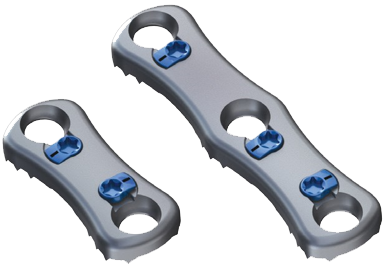
The PROWESS System provides a comprehensive solution for Laminoplasty procedures and consists of streamlined instrumentation and a variety of plate and spacer options for intraoperative adaptability. The instrumentation are intuitive and maintain secure connections to the implants. The implants are offered in a range of sizes and are color coded for easy visual identification.
Prowess Spacer Plates
4-12mm lengths (in 2mm increments) that work with various Spacers
8mm across neck, 5.7mm across center graft window
Color-coded plates allow for easy identification
Double-bend design, low-profile to allow further contouring
Anterior ridges resist slippage and increase torsional stability
Accepts Ø2.3 x 4mm Self-Tapping Bone Screw for assembly
Prowess Hook Plates
4-12mm lengths (in 2mm increments) that work with various Spacers
8mm across neck
Color-coded plates allow for easy identification
Double-bend design, low-profile to allow further contouring
Anterior ridges resist slippage and increase torsional stability
Prowess Hinge Plates
8mm across neck
Singe-bend design, low-profile to allow further contouring
Anterior ridges resist slippage and increase torsional stability
Prowess Spacers
Titanium or PEEK construction
6mm wide, and 4mm minimum height from posterior face to anterior curve
Implant Inserter grip features
Medial, lateral, and anterior anatomical curvatures
Graft cavities on all sizes
Accepts Ø2.3 x 4mm Self-Tapping Bone Screw for assembly
Titanium Spacers are color-coded for easy identification
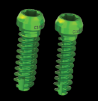
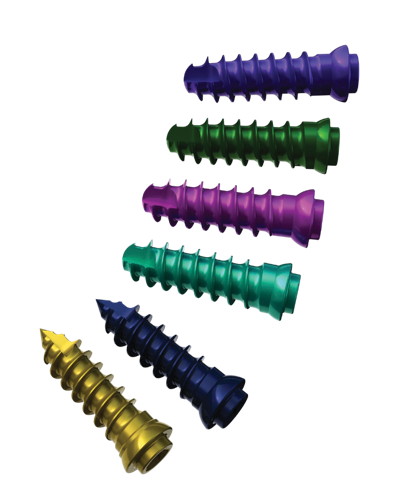
Prowess Screws
Ø2.3 and Ø2.7 in 4-12mm lengths (in 2mm increments)
Self-Drilling and Self-Tapping
Color-coded screws allow for easy identification
Works with self-retaining Screw Driver
Same Ø2.3 x 4mm Self-Tapping bone screw assembles Spacer to Spacer Plate
CuriGraft Viable Allogenic Bone Matrix
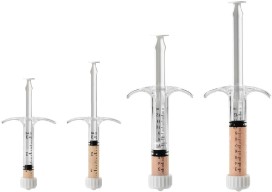
CuriGraft® Viable Allogenic Bone Matrix is the next generation allograft containing the three key elements ideal for bone formation, offering a variety of clinical applications, including the spine, upper extremity, foot and ankle and orthopedic oncology.
Key Features
Osteoconductive three-dimensional scaffold with cortical and cancellous components
Demineralized cortical bone scaffold. Demineralized cortical bone has been identified to have osteoinductive potential1
Viable endogenous bone cells to support osteogenic healing processes
DMSO-FREE cryoprotectant, requiring no rinsing or decanting
Proprietary mixture of mineralized cancellous bone along with demineralized cortical fibers
Easy-to-use syringe, just thaw and use!
Four-hour working window for implantation post thaw
Storage: -65°C or colder
Size
Product Code
1.0cc
C034-0001-MCBMV
2.5cc
C034-0025- MCBMV
5.0cc
C034-0005- MCBMV
10.0cc
C034-0010- MCBMV
Reference: 1) Gruskin, E. et.al., Demineralized bone matrix in bone repair: history and use. Advanced Drug Delivery Reviews, 2012. 64:1063-1077 Biologics
CuriGraft® DBM Putty - Demineralized Bone Matrix Putty
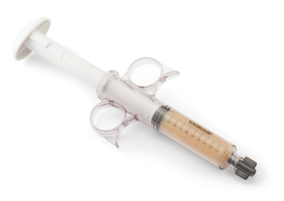
CuriGraft® DBM Putty is a demineralized bone putty matrix indicated for use in the extremities, posterolateral spine, and pelvis as a bone void filler or for treatment of osseous defects.
Key Features
Product is provided in a ready-to-use syringe
Equivalent to iliac crest autograft proven in a preclinical spinal fusion model1
Assured osteoinductivity via validated processing
Cohesive handling that resists irrigation due to robust biocompatible carrier
Patient safety ensured through terminal sterilization and viral inactivation
Cortical demineralized bone and a carboxymethyl cellulose (CMC) carrier.
Size
Product Code
1.0cc
C024-0001-PTYV
2.5cc
C024-0025-PTYV
5.0cc
C024-0005-PTYV
10.0cc
C024-0010-PTYV
Reference: 1) Kiely, P.D. et al., (2014) Evaluation of a new formulation of demineralized bone matrix putty in a rabbit posterolateral spinal fusion model. The Spine Journal. September 14(9): 2155-2163.
SI-LUTION
The SI-LUTION® Sacroiliac Joint Fusion System is designed to offer immediate stability and long-term fixation across the sacroiliac (SI) joint. The implants are machined out of Titanium and incorporate the proprietary TRU-LOK® micro-textured surface technology. The cannulated system offers screws in multiple diameters and various lengths with optional static or kinetic stabilization caps to provide an ideal solution for every patient.
Key Features
Manufactured of Titanium with proprietary surface texturing
Large centralized helical fenestrations allow for direct allograft integration
Self-harvesting bone channels to harvest and distribute local bone during insertion
The Savant Anterior Lumbar (ALIF) Interbody Fusion System features three footprints in various heights and lordotic angles offering an ideal fit for every patient.
System Features
Manufactured of Titanium Featuring TRU-LOK®
Open Architecture
Micro-roughness surface texturing produces superior implant contact
Comprehensive discectomy instruments
Three Footprints (mm): 30W x 24D, 35W x 26D, 40W x 28D
8 – 20mm, offered in 2mm increments
Lordosis: 6° and 12°
Prodigy MIS
The Prodigy MIS Pedicle Screw System is designed to minimize the complexity of procedural steps while correcting and stabilizing the posterior thoracolumbar spine through a percutaneous approach. This system provides the same strength and rigidity as the Prodigy Polyaxial Screw System.
PEDICLE SCREW SYSTEM
Key Features
Minimized soft tissue disruption
Strong interface between rod and rod inserter
Undercut square thread designed to prevent cross-threading and tulip head splaying
Simple and efficient instruments provide advanced manipulation techniques
Available in 4.5, 5.5, 6.5 and 7.5 Diameter
Heights: 30-55mm in 5mm increments
MIS ROD
Key Features
Bulleted tip to facilitate placement
Robust instrument engagement feature
PRODIGY™
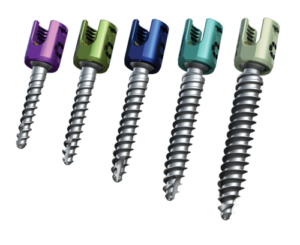
The Prodigy Polyaxial Pedicle Screw System is a posterior spinal fixation system designed to enhance the surgical experience by providing surgeons with its comprehensive implant offering and ergonomically designed instrumentation. The low-profile, friction fit design is offered in both standard and reduction geometries.
PRODIGY PEDICLE SCREW SYSTEM
Key Features
Self-tapping double lead bone screw threads
Continuous friction to maintain tulip position
Optimized instrument ports
Streamlined rod capture
Square thread designed to prevent cross-threading
Available in standard and dual-thread cortico-cancellous options
4.5 – 10.5mm diameter
Height: 25mm – 110mm lengths
5.5mm pre-bent or straight rod available
PRODIGY REDUCTION PEDICLE SCREWS
Key Features
Self-tapping double lead bone screw threads
Continuous friction to maintain tulip position
Optimized instrument ports
Streamlined rod capture
Square thread designed to prevent cross-threading
Extended tulip height of 23.5mm
26mm of threads
Reduction screws offered in 5.5 – 7.5mm in 25mm – 55mm lengths
5.5mm pre-bent or straight rod available
VARIABLE CROSSLINKS
Key Features
Versatile crosslink design with adjustable lengths and angle variability
Slim profile design
Center and lateral set screw features the same T20 hexalobe drive
64-85mm (Gold)
44-65mm (Light Blue)
34-45mm (Green)
OFFSET CONNECTORS
Key Features
20, 25 and 30 open and closed Offset Connectors
Connects to a Ø5.5mm rod
Accepts the same set screw as the pedicle screws
Flanged and smooth options
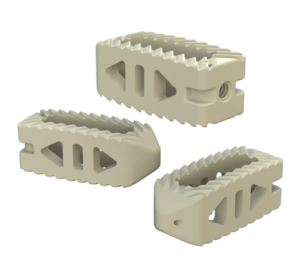
Savant TLIF
The Savant Transforaminal Lumbar (TLIF) Interbody Fusion System is offered in three different material types, multiple footprints, heights, and lordosis providing multiple options for the surgeon. The convex design offers a more accurate fit to the patient’s anatomy and offers oversized, central lateral graft windows for biologic seeding. The Savant Interbody Fusion System offers Comprehensive discectomy instruments and features instrumentation that allows for better control and more precise implant placement.
SAVANT PEEK TLIF
Key Features
Manufactured of biocompatible PEEK polymer
Strategically positioned tantalum radiopaque markers to optimize visibility and placement
Angled lateral windows on anterior side of implant to retain bone graft material
Large back surface area for increased instrument interface
Footprints (mm): 28L x 9W, 28L x 11W, 32L x 9W and 32L x 11W
Heights: 6 – 16mm, offered in 1mm increments
Lordosis: 0° or 8º
SAVANT TITANIUM TLIF
Key Features
Manufactured of Titanium Featuring TRU-LOK®
Open Architecture
Designed to offer immediate stability and long-term fixation
Micro-roughness surface texturing produces superior implant contact
Footprints (mm): 28L x 9W, 28L x 11W, 32L x 9W and 32L x 11W
Heights: 6 – 16mm, offered in 1mm increments
Lordosis: 0° or 8°
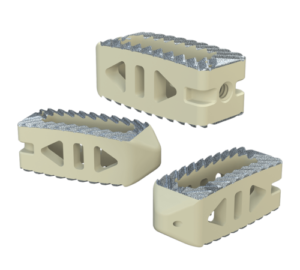
SAVANT TITANIUM PLASMA COATED TLIF
Key Features
Manufactured of PEEK with a titanium plasma spray coating
Footprints (mm): 28L x 9W, 28L x 11W, 32L x 9W and 32L x 11W
Heights: 6 – 16mm, offered in 1mm increments
Lordosis: 0° or 8º
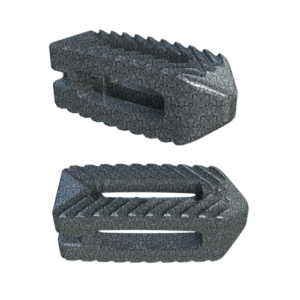
Savant PLIF
The Savant Posterior Lumbar (PLIF) Interbody Fusion System self-distracting, bulleted tip is offered in three different material types, multiple footprints, heights, and lordosis providing multiple options for the surgeon. The Savant PLIF Interbody Fusion System features instruments that are simple and intuitive to use.
SAVANT PEEK PLIF
Key Features
Manufactured of biocompatible PEEK polymer
Strategically positioned tantalum radiopaque markers to optimize visibility and placement
Multi-directional teeth resist migration
Footprints (mm): 22L x 10W, 26L x 10W and 30L x 10W
Heights: 6 – 16mm, offered in 1mm increments
Lordosis: 0° and 8
SAVANT TITANIUM PLIF
Key Features
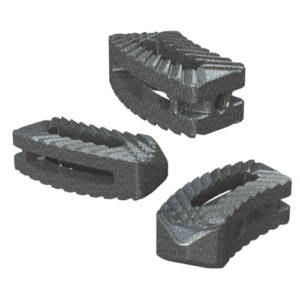
Manufactured of Titanium Featuring TRU-LOK®
Open Architecture
Micro-roughness surface texturing produces superior implant contact
Footprints (mm): 22L x 10W, 26L x 10W and 30L x 10W
Heights: 6 – 16mm, offered in 1mm increments
Lordosis: 0° or 8°
SAVANT TITANIUM PLASMA COATED PLIF
Key Features
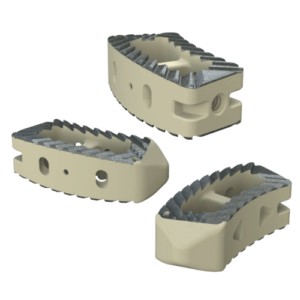
Manufactured of PEEK with a titanium plasma spray coating
Optimal Radiolucency
Increased surface topography
Footprints (mm): 22L x 10W, 26L x 10W and 30L x 10W
Heights: 6 – 16mm, offered in 1mm increments
Lordosis: 0° and 8°
Aptitude
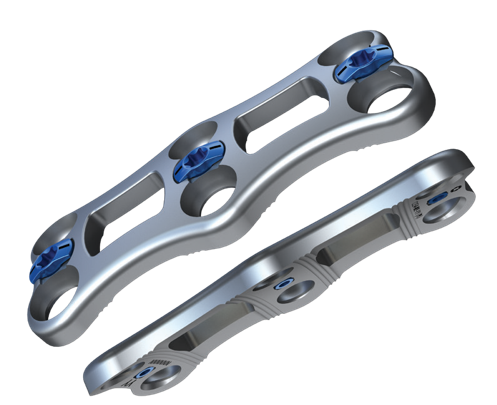
The Aptitude Cervical Plates feature a slim profile design allowing for a smooth anterior service. The simple and intuitive one-step locking mechanism facilitates complete control by the surgeon during the procedure. The Aptitude system offers streamlined instrumentation to accommodate the needs of the patients and surgeons.
ANTERIOR CERVICAL PLATES
Key Features
Low-profile Plate
Large Graft Window
Simple and effective, one-step locking mechanism
Pre-Lordosed to match patient anatomy
1-5 level plates
17mm plate width
2.2mm thick
ANTERIOR MIDLINE CERVICAL PLATES
Key Features
Small incision, minimizing lateral retraction
Narrow width optimizes post-operative visualization of the fusion site
Posterior cleats resist slippage and increase torsional stability
1-2 level plates
10.5mm plate width
2.2mm thick
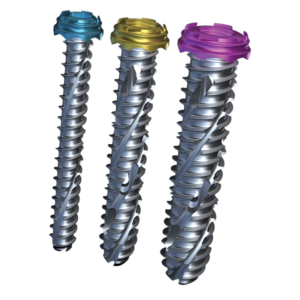
APTITUDE SCREWS
Key Features
Ø4.0 and Ø4.5 in 12-18mm lengths (in 2mm increments)
Self-Drilling, Self-Tapping, Fixed and Variable Screws
Color-coded screws allow for easy identification
Same screws used for both Standard and Midline plates
Sage
The Sage Cervical Interbody Fusion System is designed to support cervical loads while maximizing surface between the implant and vertebral bodies. The Interbody is offered in four footprints to accommodate individual patient anatomy while the streamlined instrumentation is designed to aid in consistent and accurate implant placement.
SAGE PEEK CERVICAL
Key Features
Manufactured of biocompatible PEEK polymer
Tantalum radiopaque markers to optimize visibility and placement
Multi-directional aggressive teeth designed to prevent implant migration
Large, central graft cavity for packing bone graft
Color-coded instruments for easy identification
Footprints (mm): 12W x 11D, 14W x 12D, 16W x 13D, and 18W x 14D
Heights: 5-12mm, offered in 1mm increments
Lordosis: 7°
SAGE TITANIUM CERVICAL
Key Features
Manufactured of Titanium with surface texturing
Open Architecture
Micro-roughness surface texturing produces superior implant contact
Designed to ensure a high degree of compressive strength and dimensional stability
Footprints (mm): 12W x 11D, 14W x 12D, 16W x 13D, and 18W x 14D
Heights: 5-12mm, offered in 1mm increments
Lordosis: 7°
SAGE TITANIUM COATED CERVICAL
Key Features
Manufactured of PEEK with a titanium plasma spray coating
Surface topography produces superior implant contact and construct stability
Optimal Radiolucency
Self-distracting leading edge to facilitate implant insertion
Footprints (mm): 12W x 11D, 14W x 12D, 16W x 13D, and 18W x 14D
Heights: 5-12mm, offered in 1mm increments
Lordosis: 7°
Contact Curiteva
Contact us to learn more about Curiteva’s products and technology





 System Features
 Key Features
 Key Features
 Key Features
 Key Features
 Key Features
 Key Features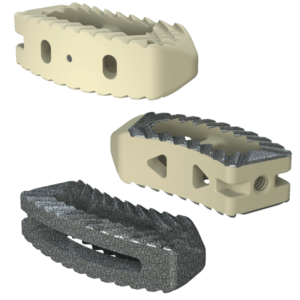
 Key Features
 Key Features
 Key Features