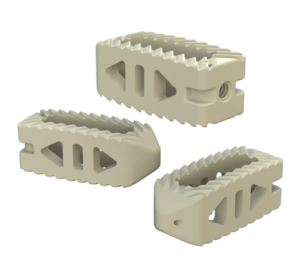
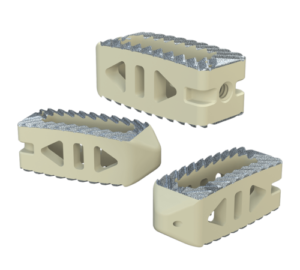
| Posterior Lumbar Interbody Fusion (PLIF) cage |
Posterior approach through the back, with access to the disc space from both sides of the spinal canal. |
Titanium, porous titanium, and radiolucent polymers such as PEEK; material availability varies by device. |
Interbody fusion for selected cases of degenerative disc disease, spondylolisthesis, or spinal instability. |
Provides posterior disc-space access; the procedure involves working near neural structures, so patient selection and surgical technique are important. |
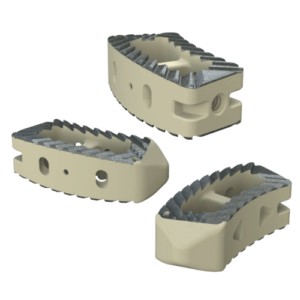
| Transforaminal Lumbar Interbody Fusion (TLIF) cage |
Posterior approach, typically entering the disc space from one side through the foraminal region. |
Titanium, porous titanium, and radiolucent polymers such as PEEK. |
Fusion for selected lumbar degenerative conditions, including cases where posterior stabilization is also indicated. |
Often designed with an angled or curved profile to facilitate insertion through a unilateral corridor; exact geometry depends on the device. |
| Anterior Lumbar Interbody Fusion (ALIF) cage |
Anterior approach through the abdomen to reach the lumbar disc space. |
Titanium, porous titanium, and radiolucent polymers such as PEEK; some designs accept supplemental fixation. |
Interbody fusion at selected lumbar levels when anterior access is clinically appropriate. |
Can accommodate a relatively large footprint, but the anterior approach has distinct access-related risks and requires appropriate surgical planning. |
| Lateral Lumbar Interbody Fusion (LLIF) cage |
Lateral approach through the side of the body; access is commonly through the psoas region. |
Titanium, porous titanium, and radiolucent polymers such as PEEK. |
Selected lumbar fusion cases, particularly when a lateral route can provide access to the target disc level. |
Not suitable for every lumbar level or patient; the approach requires consideration of the psoas muscle and nearby nerves. |
| Oblique Lumbar Interbody Fusion (OLIF) cage |
Oblique, usually retroperitoneal corridor to the disc space, avoiding a direct trans-psoas route. |
Titanium, porous titanium, and radiolucent polymers such as PEEK. |
Selected lumbar interbody fusion procedures where an oblique access corridor is feasible. |
Approach feasibility depends on individual vascular and anatomical relationships; the route does not eliminate approach-related risks. |
| Expandable interbody cage |
May be used with posterior, transforaminal, anterior, or lateral approaches, depending on the specific design. |
Commonly titanium or titanium alloy; some designs use combinations of materials. |
Cases where a compact insertion profile followed by in-situ expansion is part of the surgeon’s plan. |
Expansion mechanisms and available dimensions differ. Expansion does not guarantee fusion or a particular clinical outcome. |
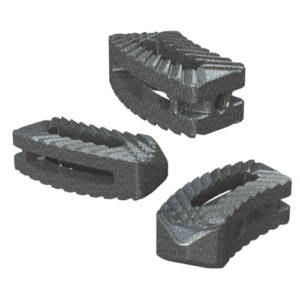
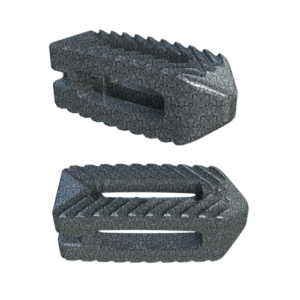
| Porous or additively manufactured interbody cage |
May be designed for use with posterior, anterior, or lateral approaches. |
Often porous titanium or titanium alloy; porous structures may be created through additive manufacturing. |
Interbody fusion when the selected cage design and material are appropriate for the planned approach and patient. |
Porous architecture and surface features vary by device. Material or surface design alone does not establish clinical superiority. |








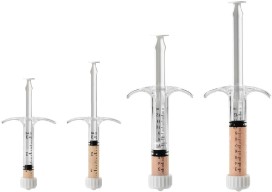
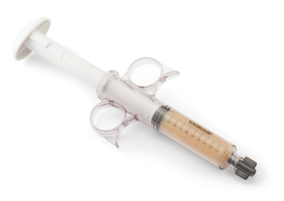
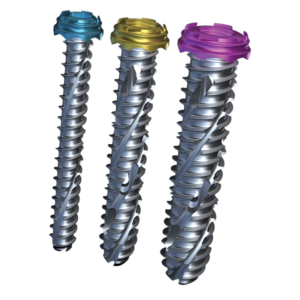

 System Features
 Key Features
 Key Features
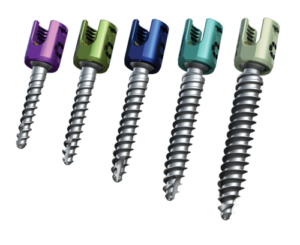 Key Features
 Key Features
 Key Features
 Key Features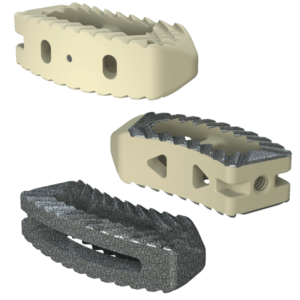
 Key Features
 Key Features
 Key Features